Is Your Browser Slow in 2026? The Real Tech Truth
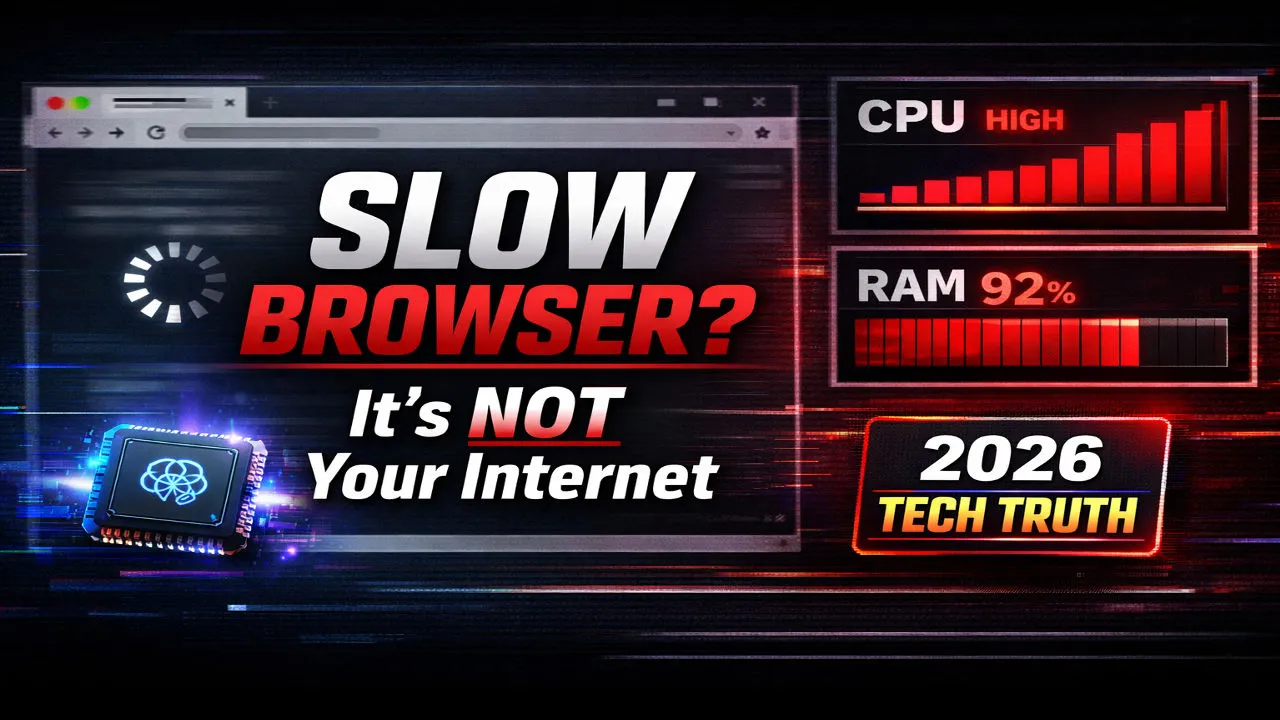
We were all promised that by 2026, with 5G and M4/M5 chips, the internet would be instant. But let's be honest—how many times a day do you stare at a loading spinner on your expensive Windows 12 or Macintosh?
It’s frustrating. Speed (Raftar) isn't just about your ISP anymore; it's about how bloated your browser has become. After testing several setups, I’ve found some microscopic reasons why your browsing feels like mud.
Direct Observation: I noticed that even on a clean 1Gbps connection, my browser was lagging during simple scrolls. That’s when I realized—the software is fighting the hardware.
1. AI-Native Browsers: The Silent Resource Hog
The biggest change in 2026 is that browsers aren't just tools anymore; they are AI hubs. Every time you open a tab, a Local LLM (Large Language Model) starts running in the background. It’s trying to "predict" your next click. Sounds cool, right? But this "Predictive Rendering" eats up nearly 40% of your CPU while you're just idle. It’s a silent killer that standard Task Managers often fail to show properly.
2. V-RAM Leakage is Real
Modern web pages are basically high-end games now. With WebGPU being the standard, your browser is constantly fighting your OS for Video RAM. If you are on an integrated graphics card, you get "Micro-Stuttering." You’ll notice this most when you have an AI sidebar open while scrolling through a media-heavy site. The frame rate just dies.
3. Tracking 2.0: Behavioral Fingerprinting
Cookies are old news. Now, trackers use "Behavioral Biometrics." They track your mouse speed, how you scroll, and where your eyes linger. Every single move you make triggers a hidden calculation. This isn't just a privacy nightmare; it's a CPU nightmare. Your browser is so busy "watching" you that it forgets to load the page quickly.
My "No-Nonsense" Comparison: 2019 vs. 2026
I looked back at how browsers behaved 7 years ago versus now. The difference is shocking.
| Feature | 2019 Era | 2026 Era |
|---|---|---|
| Logic | JS Engines | Neural/WebGPU |
| Tracking | Cookies | AI Fingerprints |
| RAM | 4GB Avg | 12GB Min |
| Processing | Simple CPU | Parallel NPU |
How I Fixed My Setup (And You Can Too)
Don't just accept a slow browser. Here’s what I did to reclaim my Raftar:
- Flush the AI Cache: Go to Privacy settings. Clear out the "Predictive Models" data. It saved me 200MB of RAM instantly.
- Stop Auto-Discarding: If you have 16GB+ RAM, turn this off. The constant re-loading of tabs in 2026 is actually slower than just keeping them in memory.
- DNS Hack: Don't use your ISP's default. Switch to 1.1.1.1. It makes the "handshake" faster.
Platform Battle: Windows vs. Mac
Windows 12 Users
The issue is "Ghost Processes." Even when you close the browser, service workers stay alive to feed the Windows AI index. Kill the 'Startup Boost' in settings immediately.
Macintosh Users
On M4/M5 chips, "Unified Memory Swap" is the culprit. When RAM hits the limit, it writes to your SSD, causing stutters. Use Safari Profiles to keep your heavy AI tasks separate.
The Final Word
The 2026 internet is fast, but our browsers are bloated with "convenience" we didn't ask for. My philosophy is simple: keep it lightweight. Strip away the background AI training, fix your DNS, and choose efficiency over flashy features. Speed is a choice.


